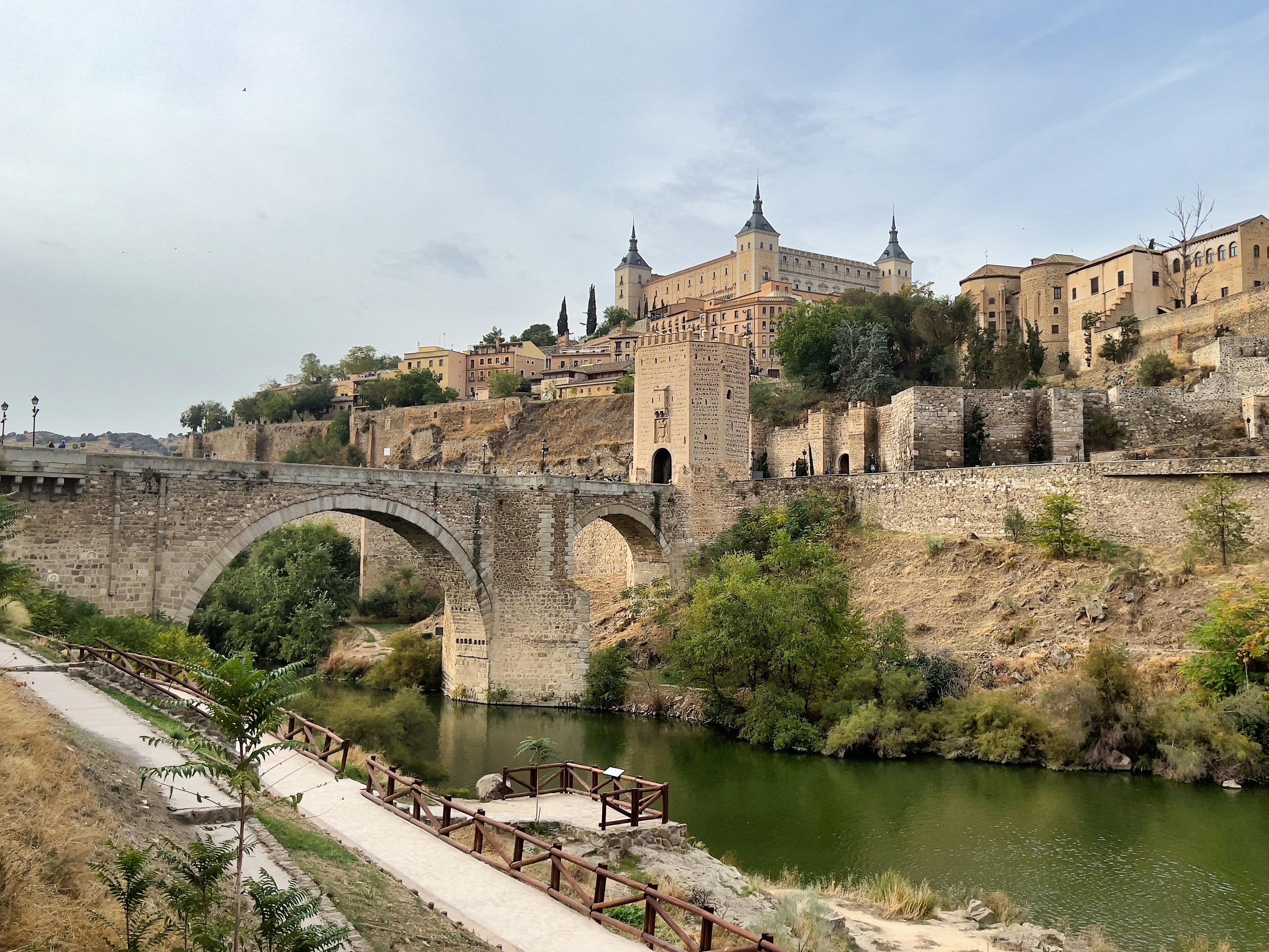
I came out of Toledo's neo-Mudéjar station on a Tuesday in March, saw the walled city sitting up on its rock across the Tagus, and started walking towards it with a screenshot of a map I had saved the night before. That map lasted around eleven minutes. Toledo's street plan was drawn under Islamic rule and never straightened out afterwards, so lanes bend back on themselves, pass under houses, and dead-end at a convent wall with no warning. Every visitor ends up in the same position eventually: standing in a beautiful alley with no idea which way the cathedral is. The good news is that this is a city where getting lost costs you very little, as long as you know roughly what you came for.
Quick Guide: Toledo on Foot
- Primary recommendation: Walk the old city east to west, from Plaza de Zocodover down to the Jewish Quarter, then come back along the river.
- Top choice for the view: The Mirador del Valle across the Tagus, best in late afternoon when the stone turns gold.
- Top choice for food: Carcamusas at Bar Ludeña on Plaza de la Magdalena, where the dish was invented in the 1950s.
- Value pick: The Toledo Tourist Bracelet.
- The best way to see the city: Take a private, personalised walking experience with Lokafy in Toledo and walk the old city with a local who knows which door is open today.
Is Toledo walkable? Yes, but it is vertical
Toledo's historic centre sits on a granite outcrop inside a loop of the Tagus, and the entire old city fits inside roughly one square kilometre. Nothing is far. What tires people out is the gradient: you climb and drop constantly, often on polished cobbles that get slick in rain.
Two things make this manageable. The first is that the old city is almost entirely pedestrian, so you are not sharing those lanes with traffic. The second is that the council built free outdoor escalators up the rock face, which spares you the worst of the initial climb. The Paseo de Recaredo escalators run Monday to Thursday from 07:00 to 23:00, Friday from 07:00 to 02:00, Saturday from 08:00 to 02:00, and Sunday and holidays from 08:00 to 23:00. The Safont escalators, closer to the bus station, open at 07:00. Both are free.
Wear shoes with grip. Leave the wheeled suitcase at your hotel or in a locker, because dragging one over these cobbles is a special kind of misery.
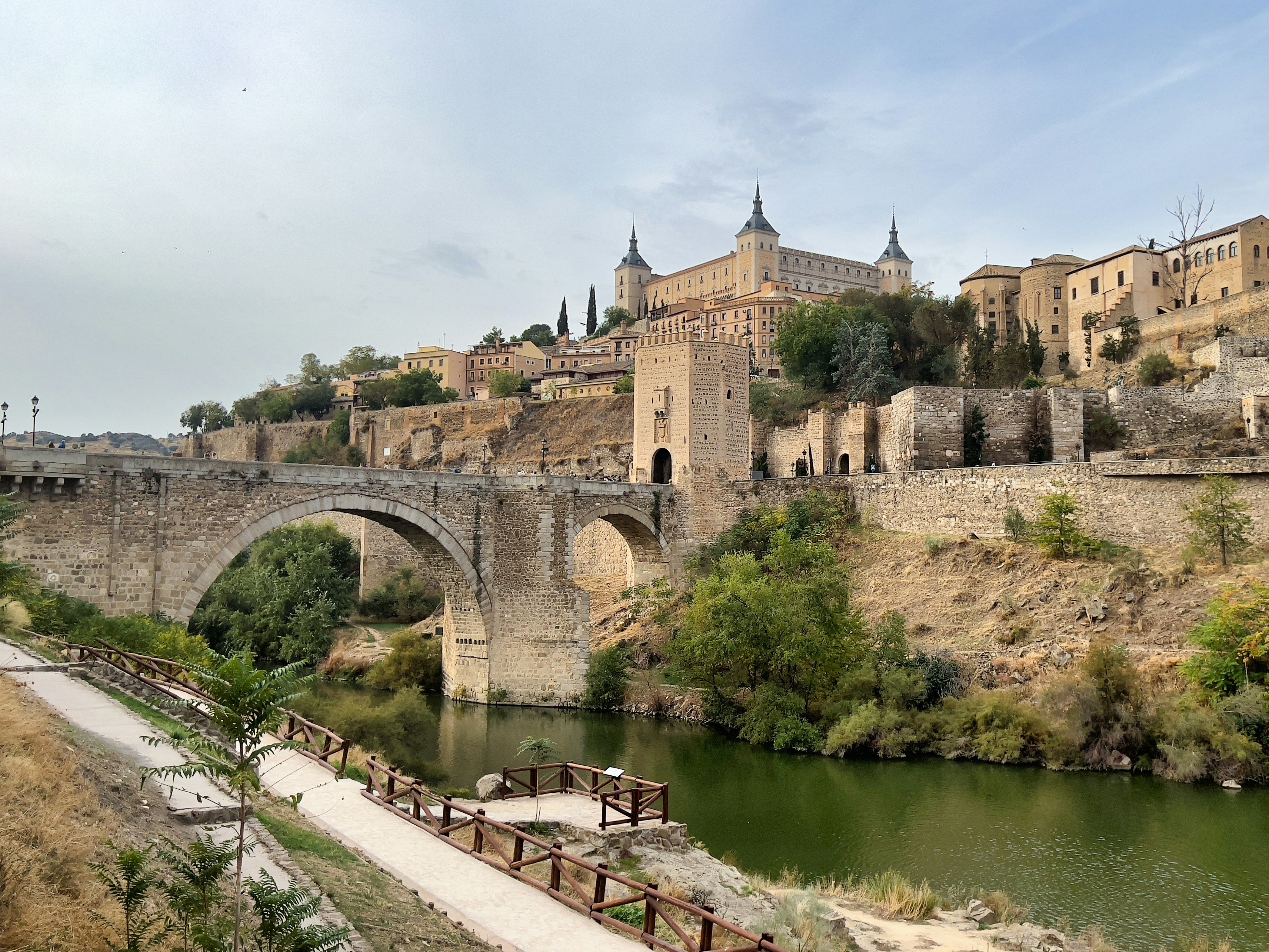
Getting into the old city from Madrid
Renfe's Avant trains run from Madrid Puerta de Atocha to Toledo in 33 minutes, with fares starting around €13.90 one way. There are fewer services on this line than you might expect for such a short hop, and weekends fill up, so book ahead rather than turning up at Atocha hoping.
From Toledo station you have three options. Walking to Plaza de Zocodover takes about 20 minutes and involves a climb, though the stretch over the Alcántara bridge is worth doing at least once. City buses on lines 5, 61 and 62 stop at Zocodover, and the fare is €1.40. Pay attention to this part: Toledo's urban buses do not take cards or phone payments, and drivers will not accept a note larger than €5 for a single fare. Carry coins. A taxi from the station to Zocodover runs around €6.
A half-day walking route through Toledo

This is the sequence that works best on foot, moving with the terrain rather than against it. Allow four hours at a slow pace, or a full day if you go inside three or four monuments.
- Start at Plaza de Zocodover. The old market square and the practical centre of everything. There is a tourist office here for opening hours, which change more often than any website suggests.
- Walk down to the Cathedral. Toledo's cathedral is the Primate Cathedral of Spain and the single most demanding building in the city to take in. General entry is €12 and visiting hours run Monday to Saturday from 10:00 to 18:30 and Sunday from 14:00 to 18:30. Give it 90 minutes. The Transparente, a baroque altarpiece with a hole cut through the ceiling above it to light the thing from behind, is the piece people remember.
- Cut through to Iglesia de Santo Tomé. El Greco's The Burial of the Count of Orgaz has hung here since 1586, in the chapel it was painted for. Seeing a painting in the room it was made for changes how it reads. Entry is €4, or included in the Tourist Bracelet.
- Continue into the Jewish Quarter. The Sinagoga del Tránsito, now the Sephardic Museum, has a cedar coffered ceiling and Mudéjar plasterwork that mixes Hebrew inscriptions with the arms of Castile and León. Entry is €3, and it closes on Mondays.
- Stop at Santa María la Blanca. Built as a synagogue in the 12th century under Christian rule by Muslim craftsmen, later a church. Horseshoe arches, white pillars, andone of the clearest illustrations anywhere of what "city of three cultures" meant on the ground.
- End the old city stretch at San Juan de los Reyes. The two-tier cloister is the quietest place in central Toledo on a busy afternoon. Look for the chains hanging on the exterior wall, left by Christian prisoners freed at Málaga in the 1480s.
- Leave through the Puerta del Cambrón and drop to the river. From here the Puente de San Martín is five minutes downhill.
- Walk back along the Senda Ecológica. The riverside path runs between the San Martín and Alcántara bridges, roughly 5 km if you do the full stretch, and it is where residents come to run and walk dogs. You pass under the San Martín bridge, past old flour mills and the scant remains of a Roman aqueduct. Almost no day trippers do this, which is the point.
Where to eat in Toledo, and what to order
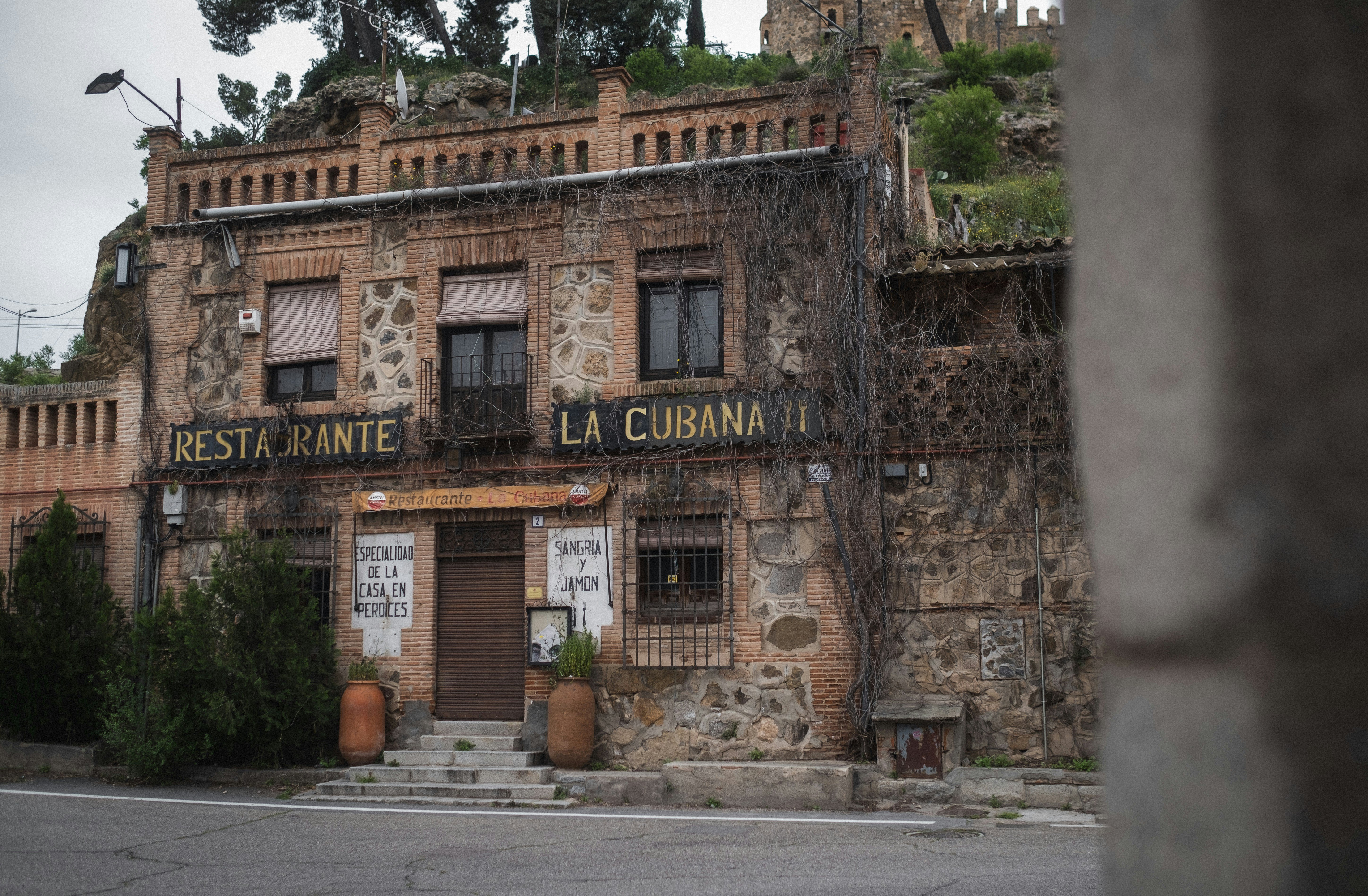
Toledo's cooking comes from Castilian hunting country: game, stews, pulses, and almonds. Three things are worth going out of your way for.
Carcamusas is the city's own dish, a stew of lean pork in a lightly spiced tomato sauce with peas, served in a clay dish with bread for mopping. It was created at Bar Ludeña on Plaza de la Magdalena, open since 1954, where the daily menu still lands between about €12.50 and €15. Ludeña closes on Wednesdays. Go at 1:30pm and stand at the bar, or go at 3pm and accept the wait.
Game and slow-cooked plates turn up on most traditional menus: stewed partridge, venison, oxtail, and callos. Lo Nuestro on Calle San Juan de Dios, in the Jewish Quarter, does these well and is easy to walk past without noticing, which tends to be a good sign in this city.
Marzipan is the souvenir, and the version sold on Calle del Comercio is not the version to buy. Local tradition traces the first Toledo marzipan to the Convento de San Clemente, where the almond and sugar paste was supposedly made to feed the city after the Battle of Las Navas de Tolosa in 1212. The nuns still sell it on Calle San Clemente through a torno, a revolving wooden hatch that lets them pass goods out without being seen. You ring, you wait, you order, the shelf turns. The best-known commercial workshop in town has been making marzipan since 1856 if the convent is not selling when you call by.
One general rule: sit down more than three minutes from a major monument and the price of the same plate drops noticeably. A menú del día away from the main streets runs €12 to €15 for a starter, a main, dessert and a drink.
The corners day trippers walk straight past

Toledo empties out in the evening, and the parts of it that stay interesting after 6pm are rarely on a first-timer's list.
The Mirador del Valle gives you the postcard view of the whole city inside its river loop. It sits on the ring road across the Tagus, about 4 km on foot from the centre with a gentle climb. Bus L71 stops on the Carretera de Circunvalación and leaves you around ten minutes' walk from the best angle. Afternoon light is better than morning light here, because the sun sits behind the old city in the morning.
The cobertizos, covered passages where upper floors of buildings bridge the street, are scattered around the convent quarter near Santo Domingo el Real. They were medieval solutions to property disputes and they photograph beautifully in low light.
The Iglesia de los Jesuitas is included in the Tourist Bracelet, and its towers are the only easy rooftop view from inside the walls. Most visitors spend their monument budget on the cathedral and skip it.
Then there is the simple move of staying overnight. The last day-trip trains pull out in the early evening, and the streets between 8pm and 11pm belong to people who live here.
Tickets, passes and the free entry windows
Toledo has a reputation as an expensive city to visit, and unplanned it easily is. Individual monument entries stack up fast.
The Toledo Tourist Bracelet costs around €14 and covers seven monuments: San Juan de los Reyes, Santo Tomé, Santa María la Blanca, the Iglesia de los Jesuitas, the Mezquita del Cristo de la Luz, the Real Colegio de Doncellas Nobles and the Iglesia del Salvador. Each of those is €4 on its own, so the maths works from four visits upwards. It is a fabric band you wear on your wrist and it is scanned at each door. Note what it does not include: the cathedral and the Alcázar.
Three free windows are worth planning around:
- The cathedral naves can be visited free through the Puerta del Reloj, Monday to Friday excluding holidays, from 08:00 to 09:30, with the door closing 15 minutes before the end. This is worship time and does not include the museums or the treasury, so keep your voice down and your camera away.
- The Sephardic Museum at the Sinagoga del Tránsito is free on Saturdays from 14:00 and all day Sunday. Arrive 15 minutes before the free session starts, because capacity is limited and the queue forms on Calle Samuel Leví.
- The Army Museum inside the Alcázar, normally around €5, is free on Wednesdays. It closes on Mondays.
Opening hours for bracelet monuments run 10:00 to 18:45 from 1 March to 15 October, and 10:00 to 17:45 from 16 October to the end of February.
When to come
Spring and autumn are the sweet spots. Castilian summers are severe, with July and August afternoons regularly past 35°C on stone that holds heat like a radiator, and the old city offers very little shade at midday.
Within a day, the pattern is predictable. Coach groups and day trippers land between 10:30 and midday and start thinning out after 5pm. If you arrive on the first train of the morning or stay a night, you get the cathedral quarter to yourself at both ends of the day. One measured comparison from a February visit: six minutes of queue at the cathedral at 11:00, over fifteen minutes at 12:30.
See Toledo with someone who lives there

Toledo is a city where the difference between a good day and a confusing one comes down to knowing which door is open, which lane connects to which square, and which bar stops serving at 4pm. A map cannot tell you that. A person who lives here can.
Take a private, personalised walking experience with Lokafy in Toledo and walk the old city with a local who will show you the passages, the convent hatches and the viewpoints they use themselves, at your pace and on your schedule. It is a walk shaped around what you want to see, with someone who can answer the questions a guidebook leaves out.
Frequently asked questions
Is Toledo walkable? Yes. The historic centre is compact, roughly one square kilometre, and almost entirely pedestrian. The challenge is the gradient and the cobbles rather than the distance. Free public escalators at Paseo de Recaredo and Safont carry you up the steepest section from the car parks and bus station.
How long do you need in Toledo? One full day covers the cathedral, the Jewish Quarter and a walk along the river. Two days lets you add the Mirador del Valle, the Alcázar and the smaller monuments without rushing, and gives you the evenings, which are the best part of staying over.
Is a private walking tour of Toledo worth it? For most first-time visitors, yes. Toledo's layout defeats maps, its opening hours shift with the season, and much of what makes the city remarkable is context you cannot see: which building was a mosque before it was a church, what the chains on San Juan de los Reyes mean, why the street bends where it does. A private walking tour with a local also moves at your speed and skips what does not interest you.
How do you get from Madrid to Toledo? Renfe Avant trains from Madrid Puerta de Atocha reach Toledo in 33 minutes, from around €13.90 one way. Services are limited, so book in advance, particularly at weekends. From Toledo station, city buses 5, 61 and 62 run to Plaza de Zocodover for €1.40 in cash, or it is a 20-minute uphill walk.
Do you need the Toledo Tourist Bracelet? It pays for itself from four monuments upwards. At around €14 against €4 per individual entry, it makes sense if you are doing San Juan de los Reyes, Santo Tomé, Santa María la Blanca and one more. If you plan to visit only one or two, buy single tickets. The bracelet does not cover the cathedral or the Alcázar.
What is the best time of day to visit Toledo? Early morning and evening. Day-trip crowds arrive around 10:30 and thin out after 5pm. Cathedral queues are noticeably shorter at 11:00 than at 12:30, and the Mirador del Valle is at its best in the late afternoon when the sun lights the old city from the front.
What food is Toledo known for? Carcamusas, a lightly spiced pork and tomato stew with peas, invented at Bar Ludeña in the 1950s. Beyond that, game dishes such as stewed partridge and venison, Manchego cheese, and marzipan, which the city has been making since at least the medieval period and which is still sold by nuns through convent hatches.
Enjoyed this article?